7 to 14
Junior Creator
Levels 5 to 8, after the four Scratch levels and before websites and apps. A complete beginner at thirteen or fourteen usually starts here, at Level 5, and moves quickly.
Junior Creator, coding and AI for ages 7 to 14 →Your privacy choices
We use cookies that are needed to run the site, and — only if you agree — cookies that measure how the site is used and how our ads perform. You can change or withdraw your choice at any time from “Cookie preferences” in the footer. Our Privacy Policy lists every tool we use and how long we keep the data.
Their first real, typed code, in the editor professionals use.
Python is where your child stops dragging blocks and starts typing real code. It's Levels 5 to 8 of Junior Creator: turtle drawing and a text adventure first, then arcade games, then data and charts, and finally machine learning they write themselves, all in VS Code.
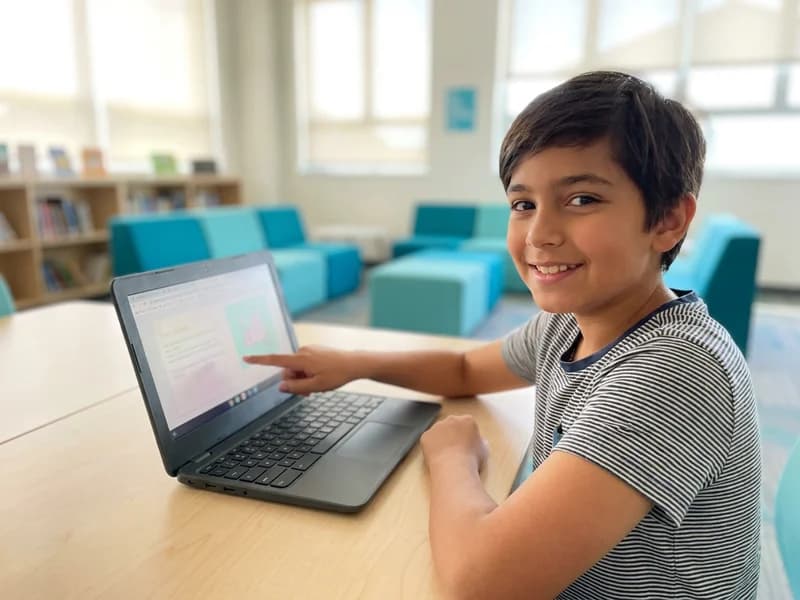
Python is Levels 5 to 8 of Junior Creator, our in-person coding program for kids ages 7 to 14, and is usually taken between ages 9 and 14. Students type real Python in VS Code, building turtle drawings, Pygame Zero arcade games, data charts and finally machine learning of their own.
Python is the second of Junior Creator's four tracks, and the language teens keep using in Ultimate Innovator.
7 to 14
Levels 5 to 8, after the four Scratch levels and before websites and apps. A complete beginner at thirteen or fourteen usually starts here, at Level 5, and moves quickly.
Junior Creator, coding and AI for ages 7 to 14 →14 to 18
Python Advanced in the software and computer science path, and Python again under Machine Learning in the AI and data path.
Ultimate Innovator, engineering for ages 14 to 18 →Each level is ten 60-minute lessons. A child who is ahead can test out of a level and move up.
Their first typed code, through turtle drawing, games and a text adventure with a talking character.
Real 2D arcade games in Pygame Zero, with enemy brains and a boss that predicts their moves.
Files, data and charts, and a miniature text generator they build themselves from counted patterns.
Machine learning end to end: classifiers, a neuron, hand tracking, and an AI running on the class laptop.
Most children arrive at Python after the four Scratch levels, when the logic is already familiar and the typing is the new part. Level 5 starts them on turtle drawing, games and a text adventure.
An older beginner doesn't have to go back to blocks. A thirteen or fourteen-year-old new to coding still starts in Junior Creator, usually at Level 5. Either way, the instructor recommends the level after watching your child build something in the free trial class.
Nothing needs buying at home. Every tool in the program is free, and everything is provided at the centre.
19 centres across Ontario, British Columbia and Alberta. Schedules and prices are set by each centre and shown on its own page.
Most reach it after the four Scratch levels, usually between nine and twelve. A beginner at thirteen or fourteen can start straight at Level 5. The free trial class is where the instructor recommends the right level.
Not always. An older beginner may start at Level 5 and move faster, and a practical exam lets any student skip a level they have outgrown.
Turtle drawings, games and a text adventure in Level 5; 2D arcade games in Pygame Zero in Level 6; files, data, charts and a miniature text generator in Level 7; and machine learning end to end, from classifiers to an AI running on the class laptop, in Level 8.
Python in Visual Studio Code, the editor professional developers use, with Pygame Zero for the arcade games. Every tool is free, and nothing needs buying at home.
Every level is ten 60-minute lessons, so it depends on how often your child comes: once, twice or three times a week. A student who is ahead can test out of a level and move up.
Websites and apps, Levels 9 to 12 of Junior Creator: HTML, CSS and JavaScript, ending in a product shipped to a real user. Teens who want more Python carry on with it in Ultimate Innovator.
Yes. Junior Creator runs online as live classes, with the same instructor-to-student ratio as a class in a centre.
One free class at your local centre. Your child builds something, and the instructor tells you honestly which level fits.