AI for kids

AI Classes for Kids and Teens Ages 7 to 18

Not a chatbot demo. Five steps, from using AI to directing it.

Your child learns AI the way they learn to code: by building it. They train an image model by Level 3, build a miniature text generator in Level 7, run a private AI on the class laptop in Level 8, and finish with an AI project of their own. Teens carry on in an AI and data path.

  • Ages 7 to 18
  • Five steps, in order
  • 6 students per instructor
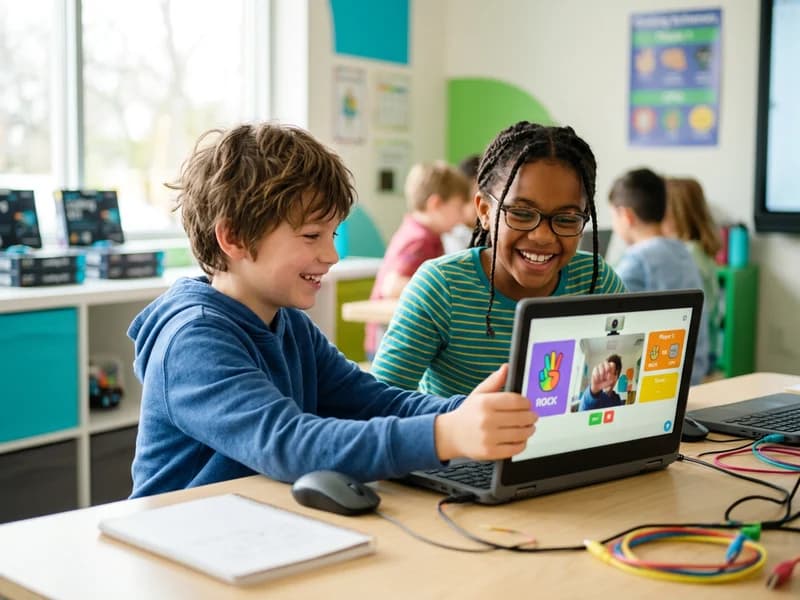
Two students at a laptop playing rock, paper, scissors against an image model they trained

What your child does in our AI classes

Our AI classes for kids ages 7 to 14 are part of Junior Creator, an in-person coding program. Students train an image model in Level 3, build a miniature text generator in Level 7, run a private AI on the class laptop in Level 8, and finish with an AI project of their own in Level 13. Teens ages 14 to 18 carry on in Ultimate Innovator's AI and data path.

Where the AI work happens

AI runs through our coding programs rather than being sold on its own, because a child who can code is the one who can tell when an AI has got it wrong.

7 to 14

Junior Creator

Five steps across thirteen levels: using AI, writing the rules a game character follows, training models on data they collected, building a text generator, and directing an AI assistant.

Junior Creator, coding and AI for ages 7 to 14 →
14 to 18

Ultimate Innovator

The AI and data path: what a model is and how one gets trained, then datasets, fine-tuning and generative AI, then machine learning, finishing able to say what their model does badly and why.

Ultimate Innovator, engineering for ages 14 to 18 →

How we teach AI, in five steps

Your child always knows which step they are on, and can tell you the difference between the five.

  1. 1

    Using AI

    Their project uses AI someone else built: speech and translation, from Level 1.

  2. 2

    Rule AI

    They write every rule the brain follows: enemies that sense, decide and act, and their own chatbot.

  3. 3

    Trained AI

    No rules written. The machine learns from examples your child gathered, then shows what the data left out.

  4. 4

    Generative AI

    They build the thing that predicts and creates: a miniature text generator, which is how the big ones stop being magic.

  5. 5

    Directing AI

    They direct an AI assistant, then verify, test and take responsibility for its work before trusting it.

The AI they build, level by level

The Junior Creator levels where your child builds or trains an AI themselves. The levels between them build the coding those projects stand on.

  1. 3
    Level 3: Scratch IntermediateAI Trainer

    Functions, lists and generative art, plus a real image model they train and then play at rock, paper, scissors.

    Ages 8 to 11
  2. 4
    Level 4: Scratch AdvancedMaster Builder

    Physics, particles and procedural worlds, plus a trainable neuron that learns in front of them.

    Ages 9 to 12
  3. 7
    Level 7: Python IntermediateData Detective

    Files, data and charts, and a miniature text generator they build themselves from counted patterns.

    Ages 10 to 13
  4. 8
    Level 8: Python AdvancedThe AI Coder

    Machine learning end to end: classifiers, a neuron, hand tracking, and an AI running on the class laptop.

    Ages 11 to 14
  5. 10
    Level 10: Web Development BeginnerInteractive Designer

    Real interactivity: events, design systems, saved data, and a page controlled by a model they trained.

    Ages 11 to 13
  6. 11
    Level 11: Web Development IntermediateApp Builder

    Web apps with state and live data, plus neural networks running inside the browser they built.

    Ages 11 to 14
  7. 13
    Level 13: AI Project StudioThe Final Project

    One signature AI product of their own invention: specify, build, test, evaluate and pitch it.

    Ages 12 to 14

See all thirteen Junior Creator levels →

Is the AI work real, or is it a marketing word?

Real, and deliberately honest. Students train models on data they collect, write a classifier and a neuron themselves, build a miniature text generator, and in Level 8 run a large language model on the classroom laptop and check it for bias.

The AI tools run on the classroom laptop rather than the cloud, so no child's camera image, voice or writing leaves the room. Every tool is free, and families buy nothing.

We never call an if-then block real AI. We teach your child the difference, so that when they say they built an AI, they can tell you exactly what they mean.

Find a location near you

19 centres across Ontario, British Columbia and Alberta. Schedules and prices are set by each centre and shown on its own page.

Questions parents ask

What age can my child start learning AI?

Seven, in Junior Creator. Their first projects use AI someone else built, like speech and translation, and by Level 3 they are training an image model of their own. At five to seven, Junior Thinker builds the groundwork: clear instructions, noticing what went wrong and trying again. A five-year-old isn't building AI, and we won't tell you otherwise.

Is the AI work real, or is it a marketing word?

Real, and deliberately honest. Students train models on data they collect, write a classifier and a neuron themselves, build a miniature text generator, and in Level 8 run a large language model on the classroom laptop and check it for bias. We never call an if-then rule real AI, and we teach the difference explicitly.

If AI can write code, why should my child learn to?

Because AI produces code but can't judge it. Deciding what to build, spotting what is subtly wrong and knowing what good looks like all come from having built things. Children who code end up directing AI; children who don't are left trusting it.

Do my child's photos or voice leave the classroom?

No. The AI tools in Junior Creator run on the classroom laptop rather than the cloud, so no child's camera image, voice or writing leaves the room.

Does my child need to code before starting AI?

No. Junior Creator starts from nothing, and the AI work comes in the same order as the coding: a child writes rules before they train a model, and trains a model before they build one.

Is there an AI course for teenagers?

Yes. Ultimate Innovator, for ages 14 to 18, has an AI and data path. Artificial Intelligence starts from what a model is and how one gets trained; Machine Learning goes deeper and is usually taken after Python Advanced.

Is there an online option?

Junior Creator and Ultimate Innovator both run online, as live classes with the same instructor-to-student ratio as a class in a centre.

Codey, the Ultimate Coders mascot, celebrating

Ask them how their AI learns. The first class is free.

Sixty minutes in a real class. Your child builds something, and the instructor tells you honestly which level fits.